Rietveld / Early Video Works
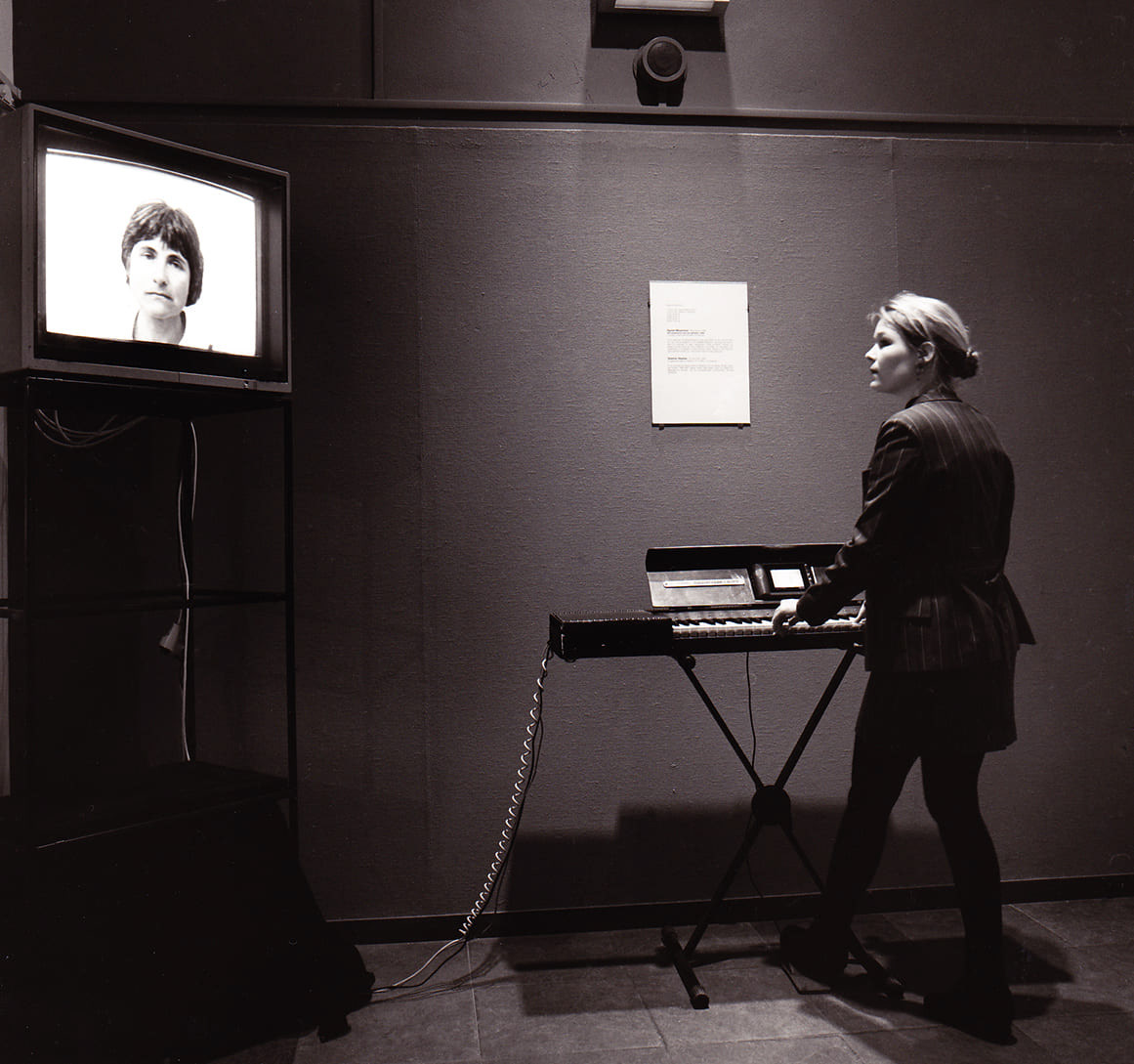
Het wegsterven van een glimlach (Fading of a Smile), 1995
Interactive video installation, Stedelijk Museum Amsterdam
Agniet Snoep recorded people as their smiles slowly disappeared. The work was presented at the Stedelijk Museum Amsterdam in 1995, in the context of Couplet IV, under Rudi Fuchs.
The installation was developed with technical support from MonteVideo / Time Based Arts and Shaun O’Neill.
The original 1995 Stedelijk Museum Bulletin text about the work is included below on this page.
Name note: At the time, Agniet Snoep worked under the name Agniet Meijerman; some contemporary publications use the spelling Agniet Meyerman.
..
Lokken, 1993
Experimental video, 2 min.
Experimental video, 2 min.
A short, rhythmic video work in which silhouetted figures produce an animal-like sound. Lokken was selected for the Netherlands Film Festival 1993.
The performers include friends and fellow artists from Agniet Snoep’s circle at the time, among them Jos Houweling, Harry Heyink, Martin Grootenboer, Rob Schröder, Fiona Tan, and Christiaan Zwanikken.
..
Het Paleis van de Koning, 1998
Film about artist Krijn de Koning, made for Double You Street
Het Paleis van de Koning is a film by Agniet Snoep about artist Krijn de Koning, made in collaboration with Martin Grootenboer for Double You Street. The project brought together fifteen filmmakers to create individual portraits of artists associated with W139 in Amsterdam. (00:27:16)
Camera: Marco Nauta
Sound: Pepijn Aben
Sound: Pepijn Aben
Double You Street was presented at IDFA and the Netherlands Film Festival.
Agniet Meyerman
Het wegsterven van een glimlach
Gebiologeerd door het scala van subtiele gradaties waarover de menselijke mimiek beschikt stelde Agniet Meyerman een reeks audiovisuele portretten samen. Bestudering van deze ‘fysionomische encyclopedie’ vormt het uitgangspunt voor haar videowerk. Met het Archief van Stemmingen besloot ze vorig jaar een audio-visuele opleiding aan de Rietveldacademie te Amsterdam.
Een aantal maanden geleden vroeg ze passanten in het Stedelijk Museum om te poseren voor haar werk Het wegsterven van een glimlach. Daarvoor had zij de videocamera, opgesteld als in een pasfotoscéance: het kader constant close-up, direct licht, synchroon geluid. Op commando lieten zij hun glimlach verlopen, zonder theatraal te worden. Om het natuurlijke verloop te respecteren liet Meyerman montage-ingrepen achterwege. De gezichten bewegen naturel, in ‘real time’.
Video-orgel
Meyermans inventaris, 25 wegstervende glimlachen, werd gedigitaliseerd ondergebracht in een video-orgel (technisch verzorgd door Shaun O’Neil en vormgegeven door Peter Giele). De bezoeker bespeelt het stemmingsorgel. 25 toetsen corresponderen met 25 lachende gezichten. Bij het indrukken van een toets verschijnt één glimlachend gezicht, dat op de maat van de bespeler in mineur geraakt.
Geroezemoes is hoorbaar zolang de installatie onaangeraakt blijft. Telkens wanneer de bezoeker het ‘toonbeeldklavier’ in werking zet door een toets aan te slaan, overvalt hem een oorverdovende stilte. Het nadrukkelijk uitblijven van het geluid, beklemtoont de concentratie op het beeld.
Het pedaal fungeert hier niet ter nuancering van het geluid, maar als tuner van het gemoed. Beroering van het pedaal bepaalt het tempo waarin en de intensiteit waarmee het gelaat vervormt.
Op het eerste gezicht lijkt de beschouwer de emotie van een onbekend persoon te sturen. Niet het personage achter het gezicht, niet de videokunstenaar, maar de kijker controleert het mimisch gedrag. Voyeuristische genoegens zullen echter omslaan in een unheimisch gevoel. Meyermans detaillistische ontleding van het menselijk masker blijkt vervreemdend te werken. In de eigen manipulatieve macht resoneert onmacht: een gevoel van onmacht ten aanzien van eigen emoties.
JELLICHJE REIJNDERS
Bulletin Stedelijk Museum Amsterdam
februari–maart 1995
februari–maart 1995
Agniet Meyerman
The Fading of a Smile
Fascinated by the range of subtle gradations available to human facial expression, Agniet Meyerman assembled a series of audiovisual portraits. The study of this ‘physiognomic encyclopaedia’ forms the starting point for her video work. Last year she completed her audiovisual studies at the Rietveld Academy in Amsterdam with Archive of Moods.
A few months ago, she asked visitors to the Stedelijk Museum to pose for her work The Fading of a Smile. For this, she set up the video camera as if for a passport-photo session: a constant close-up frame, direct lighting and synchronous sound. On command, the participants allowed their smiles to fade, without becoming theatrical. To preserve the natural progression, Meyerman refrained from editing. The faces move naturally, in ‘real time’.
Video Organ
Meyerman’s inventory of 25 fading smiles was digitised and incorporated into a video organ (technical realisation by Shaun O’Neil, design by Peter Giele). The visitor plays this mood organ. Twenty-five keys correspond to twenty-five smiling faces. When a key is pressed, one smiling face appears and, at the player’s pace, gradually takes on a more sombre expression.
A murmur of voices can be heard as long as the installation remains untouched. Each time the visitor activates the ‘image keyboard’ by pressing a key, an overwhelming silence descends. The emphatic absence of sound intensifies the concentration on the image.
The pedal does not serve to modulate the sound, but rather to tune the mood. Moving the pedal determines both the speed and the intensity with which the face changes.
At first sight, the viewer appears to control the emotion of an unknown person. It is not the person behind the face, nor the video artist, but the viewer who controls the facial expression. Yet the voyeuristic pleasure eventually gives way to an uncanny feeling. Meyerman’s detailed dissection of the human mask has an alienating effect. Within the viewer’s own power to manipulate resonates a sense of powerlessness: a feeling of powerlessness in relation to one’s own emotions.
JELLICHJE REIJNDERS